

The Bruce Overnight Edge: Do I Like Big Splits?
July 17, 2026 - Chicago, IL
Theoretically, forward and reverse stock splits are non-events. Whether you own one $100 bill or five $20 bills, your buying power and risk profile remain identical. However, markets are not purely theoretical and many other factors come into play. Forward splits are designed to lower the absolute share price so that it is generally more approachable for investors while reverse splits seek to increase the absolute share price to preserve the liquidity of options, relax margin restrictions, and avoid delisting. Absolute share price plays a critical role in market structure influencing order flow, volume velocity, and symbol engagement.
This week, we saw an interesting natural experiment when two overnight favorites underwent opposing corporate actions: SOXS (Direxion Daily Semiconductor Bear 3X Shares) executed a 1-for-10 reverse split, while KORU (Direxion Daily South Korea Bull 3X Shares) executed a 20-for-1 forward split. Both splits occurred on July 15th and per Bruce ATS policy were halted for trading for the session starting the night of Tuesday July 14th. For the study1, we compared pre-split Month-to-Date (MTD) data against two-days of post-split data (July 16–17). All data is from July 2026 Bruce ATS and there is an admittedly small post-split sample size, but the numbers are interesting nonetheless.
The KORU Forward Split (20-for-1)
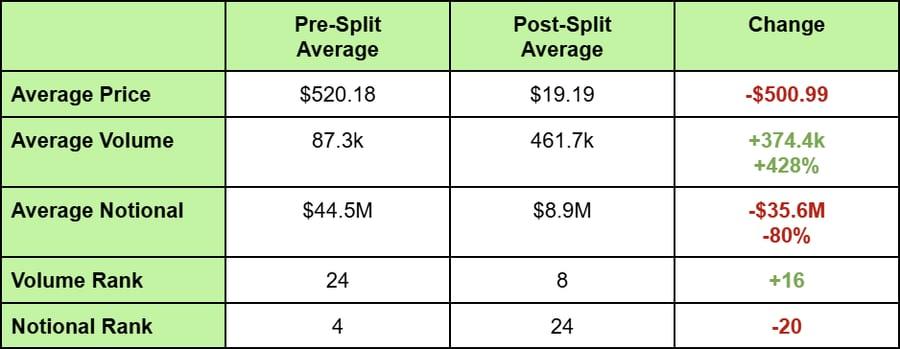
The KORU Reality
While a 428% increase in share volume looks impressive, it actually fell well short of the theoretical volume expectation. If volume scaled perfectly with the 20-for-1 split, KORU should have traded 1.74M shares. By only trading 461k shares at the new price level, KORU captured only 26.5% of post-split volume theoretical expectations. The notional average value traded on Bruce ATS dropped accordingly from $44.5 million to just $8.9 million. So, the lower price tag on KORU has not (yet) attracted the same amount of trading capital.
The SOXS Reverse Split (1-for-10)

The SOXS Reality
A 1-for-10 reverse split implies that volume should naturally drop to 10% of its previous average (roughly 700k shares). At 590k post-split shares, SOXS captured 84.2% of the theoretical volume expectation. Despite falling short on shares traded, the stock price rallied post split and made up for shares shortfall in notional terms. The post-split average session notional rose from $29.7M to $31.2M. The post-split SOXS numbers are significantly closer to the theoretical predictions than the KORU numbers.
The Open Question
The post-split sample size here was small and we acknowledge that there are many factors that affect markets. However, the SOXS forward split retained performance much closer to the theoretical expectations than the KORU reverse split. Factors such as the SOXS ratio (1:10) being half that of KORU (20:1), uncertainty in the Korean market and specifically leveraged ETFs, and psychology related to absolute stock prices all may have played a role. While we don’t have a definitive answer in the case of these two splits, we here at BOE found it interesting and hope that you did as well.
By The Numbers
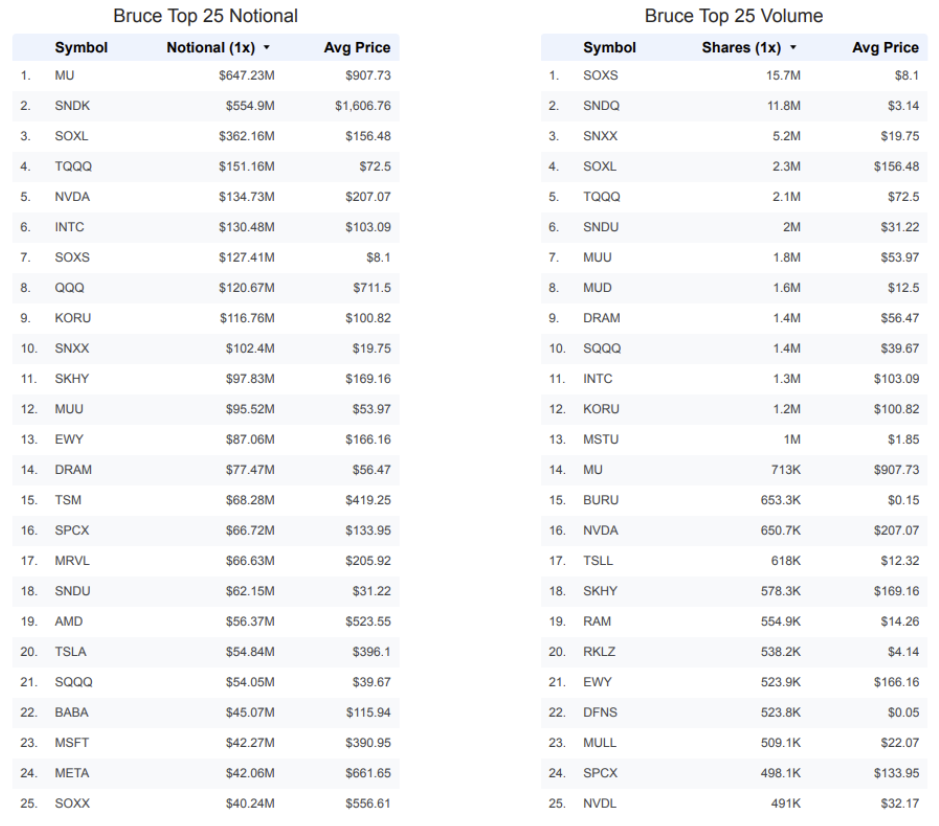
Weekly Top 25 Symbols2
Overnight News
- Our CEO, Jason Wallach, is excited to participate in Exegy’s 24/5 Trading: The Infrastructure Shift Behind Always-On Markets webinar next week on July 22nd.
- In addition, be sure to read Jason’s recent op-ed in Traders magazine: The Buy Side’s 24-Hour Trading Debate is Asking the Wrong Question
The Bruce Markets Team
1This analysis is sample-based and does not represent, predict, or guarantee outcomes for any other dataset or symbol event.
2Top 25 data is from internal Bruce ATS sources through trade date 07/17/2026.